
When Does the Texas Answer Deadline Start Running?
In Texas civil cases, the answer deadline does not begin to run simply because a lawsuit has been filed. The timing of an answer is triggered by service of citation, and the precise event that starts the clock is often misunderstood.
This article explains when the Texas answer deadline begins to run, identifies the operative triggering events, and clarifies common points of confusion. It addresses timing only and does not analyze whether service was proper or subject to challenge.
The Answer Deadline Is Triggered by Service, Not Filing
A recurring misconception is that the answer deadline runs from the date a petition is filed with the court. That is incorrect.
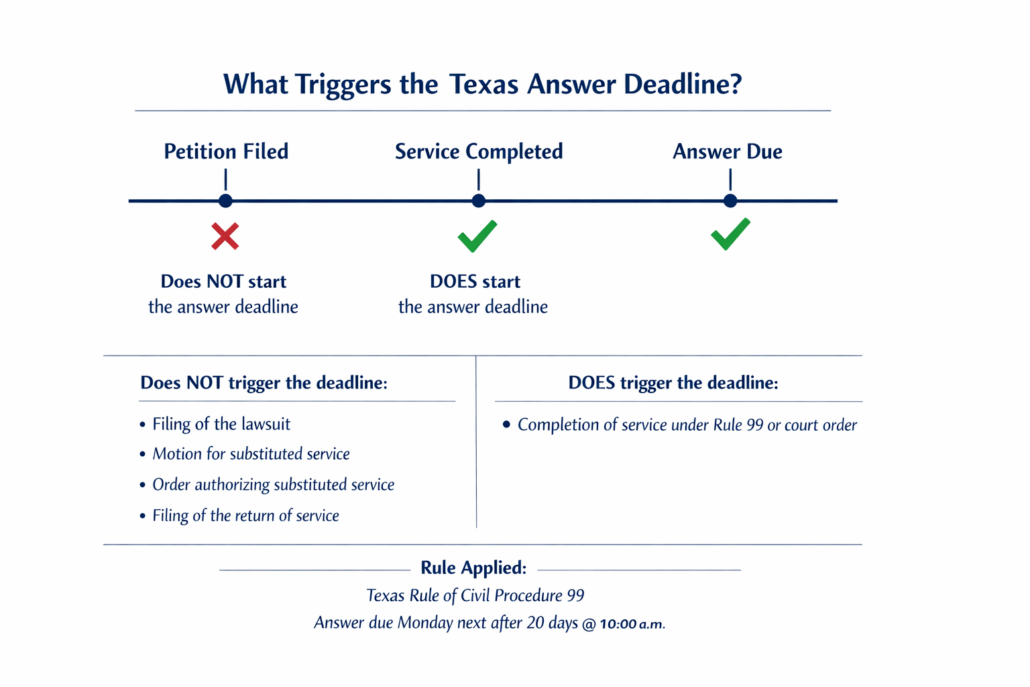
In Texas civil practice, the answer deadline is triggered by service of citation and petition on the defendant, not by the filing of the lawsuit.
Until a defendant is served, no answer deadline exists under the Texas Rules of Civil Procedure.
What Constitutes the Triggering Event?
The event that starts the answer period is the completion of service in accordance with the applicable rules or court order.
Depending on the circumstances, this may include:
- Personal service on the defendant,
- Service through an authorized agent,
- Substituted service authorized by court order, or
- Another method of service permitted by rule or statute.
The key inquiry is when service is completed, not when it is authorized, requested, or documented.
The Role of the Return of Service
The return of service is frequently mistaken for the triggering event. It is not.
The return of service:
- Documents when and how service occurred, and
- Provides evidence of completion of service.
However, the answer deadline runs from the date service was completed, even if the return of service is filed later.
While the return is often the best source for confirming the service date, it does not itself create or delay the deadline.
How Rule 99 Operates Once Service Is Completed
Once service has been completed, Texas Rule of Civil Procedure 99 governs the timing of the answer in most civil cases.
Under Rule 99, the answer is due:
At 10:00 a.m. on the Monday next after the expiration of 20 days after service is completed.
Accordingly, the calculation involves several steps:
- Identify the date service was completed,
- Exclude the day of service,
- Count twenty days,
- Identify the next Monday after that period expires, and
- Calendar the answer deadline for 10:00 a.m. on that Monday, subject to weekend and holiday adjustments.
Service by Substituted or Alternative Methods
When service is completed by substituted or alternative means, the triggering event remains the same: completion of service under the authorized method.
The answer deadline does not run from:
- The date the motion for substituted service is granted,
- The date the court signs the order authorizing service, or
- The date the plaintiff files proof of service.
Instead, the deadline runs from the date service is actually completed in compliance with the court’s order.
Service by Mail, Posting, or Other Authorized Means
If service is authorized by mail, posting, or another non-personal method, the answer deadline still runs from the date service is completed, not from the date the defendant receives or reads the documents.
Actual notice may be relevant to other issues, but it does not alter the mechanical calculation of the answer deadline under Rule 99.
Amended or Corrected Service
When service is quashed, reissued, or otherwise corrected, the answer deadline may change.
In such circumstances:
- The deadline is typically recalculated from the date valid service is completed, and
- Prior defective service generally does not start the answer period.
Because service issues can alter the triggering event, deadlines should be recalculated whenever amended or corrected service occurs.
Effect of Court Orders on the Triggering Event
Although Rule 99 establishes the default framework, court orders may modify when or how an answer is due.
A court order may:
- Set a specific answer date,
- Shorten the time to respond, or
- Impose additional response obligations.
When a court order specifies an answer deadline, that order controls regardless of when service was completed.
Common Sources of Confusion
Several recurring misunderstandings contribute to miscalculated answer deadlines:
- Treating the filing date as the trigger
- Assuming the deadline runs from the return of service
- Believing authorization of substituted service starts the clock
- Overlooking amended or corrected service
- Ignoring court-ordered response dates
Each of these errors stems from focusing on procedural steps surrounding service, rather than the actual completion of service itself.
Practical Considerations for Calendaring
Because the answer deadline is triggered by service, best practices include:
- Reviewing the return of service promptly,
- Confirming the exact date service was completed,
- Recalculating deadlines after amended or substituted service,
- Checking for early court orders affecting response timing, and
- Calendaring conservatively when service dates are unclear.
Answer deadlines may arise unexpectedly, particularly in cases involving delayed or alternative service methods.
Related Texas Deadline Resources
- Texas Answer Deadline Chart
- Texas Answer Deadline Calculator
- Substituted Service and Texas Answer Deadlines
- Common Mistakes When Calculating Texas Answer Deadlines
If you want, next I can: